
Understanding hair dryer voltage requirements across different countries is crucial for international travelers, hair salons, and businesses in the beauty industry. Using the wrong voltage can damage your equipment or create safety hazards.
Hair dryers are designed to match the standard electrical voltages of different countries: North America uses 110-127V (typically 120V), while Europe, most of Asia, Australia, and Africa use 220-240V (typically 230V). This voltage difference is crucial for both safety and performance when traveling or importing hair styling equipment internationally.
Let’s explore everything you need to know about hair dryer voltages worldwide to ensure safe and effective operation.
Why Does Hair Dryer Voltage Matter?
Understanding voltage requirements matters because it directly affects the safety and performance of your hair styling equipment.
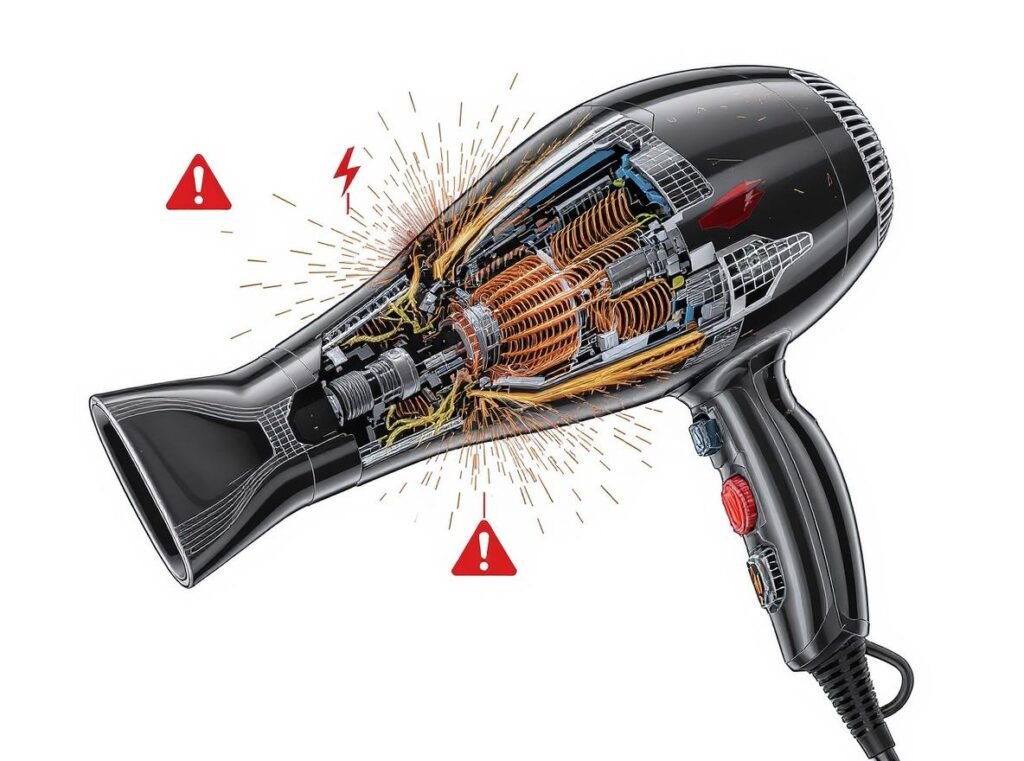
Voltage compatibility is critical for hair dryers because incorrect voltage can cause equipment damage, safety hazards, or poor performance. Using a 120V hair dryer on 220V will cause overheating and may destroy the appliance, while using a 220V dryer on 120V will result in weak airflow and poor heat output.
American appliances run on 110-120 volts at 60 Hz, while European appliances run on 220-230 volts at 50 Hz. This fundamental difference means direct compatibility issues exist between regions.
When voltage doesn’t match, several problems occur:
- Motor damage: Motors run twice as fast on higher voltage
- Heating element failure: Elements get twice as hot, burning out quickly
- Fire hazards: Overheated components can spark electrical fires
- Performance issues: Incorrect voltage affects drying efficiency
The power consumption also changes dramatically. A 1000W hair dryer designed for 110V will consume nearly 4000W on 220V power, far exceeding its design limits.
What Voltage Do Hair Dryers Use in North America?
North American hair dryers operate on a standardized lower voltage system compared to most other regions.
Hair dryers in North America (United States, Canada, Mexico) operate on 110-127 volts, most commonly 120V. This lower voltage system requires higher current to achieve the same power output as higher voltage systems used in other regions.
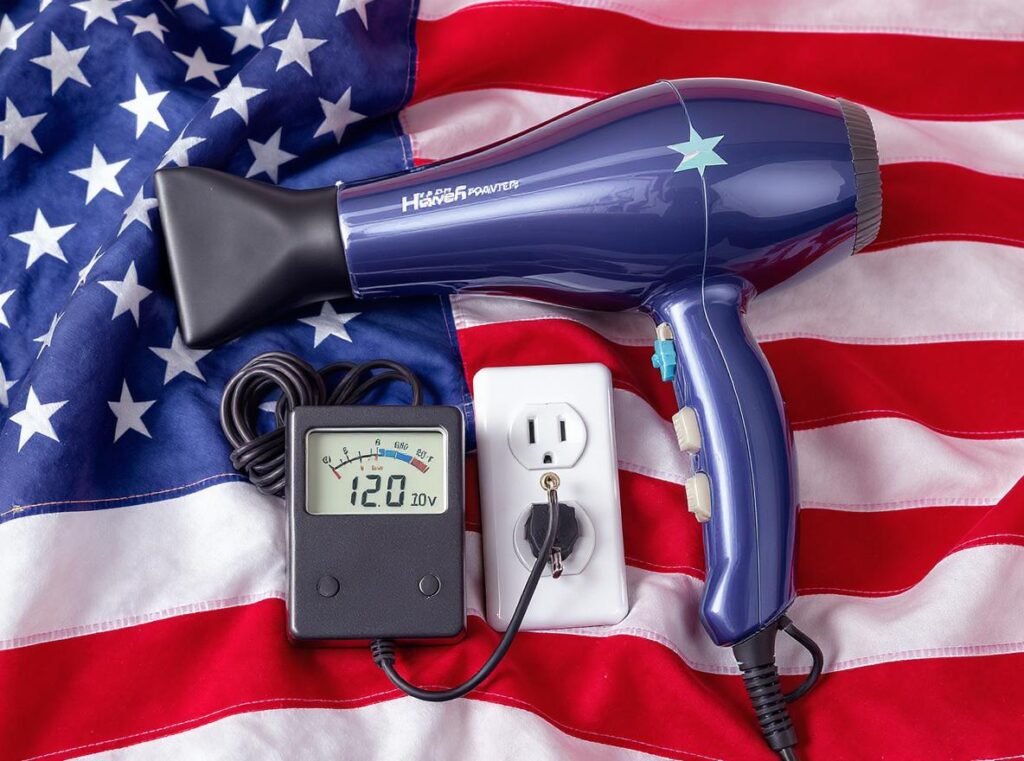
The standard specifications for North American hair dryers include:
- Voltage: 110-127V (typically 120V)
- Frequency: 60 Hz
- Power: Typically 1000-1875 watts
- Plug type: Two-prong flat blade or three-prong grounded
| Country | Voltage | Frequency | Plug Type |
|---|---|---|---|
| United States | 120V | 60 Hz | Type A/B |
| Canada | 120V | 60 Hz | Type A/B |
| Mexico | 127V | 60 Hz | Type A/B |
This voltage standard dates back to early electrical infrastructure development in North America. The lower voltage was considered safer for residential use, though it requires thicker wiring to carry higher current for the same power output.
Professional salon equipment in North America often uses higher voltages (208V or 240V) for more powerful performance, but consumer hair dryers consistently use the 110-120V standard.
What Voltage Do Hair Dryers Use in Europe?
European hair dryers operate on a higher voltage system that provides more efficient power delivery.
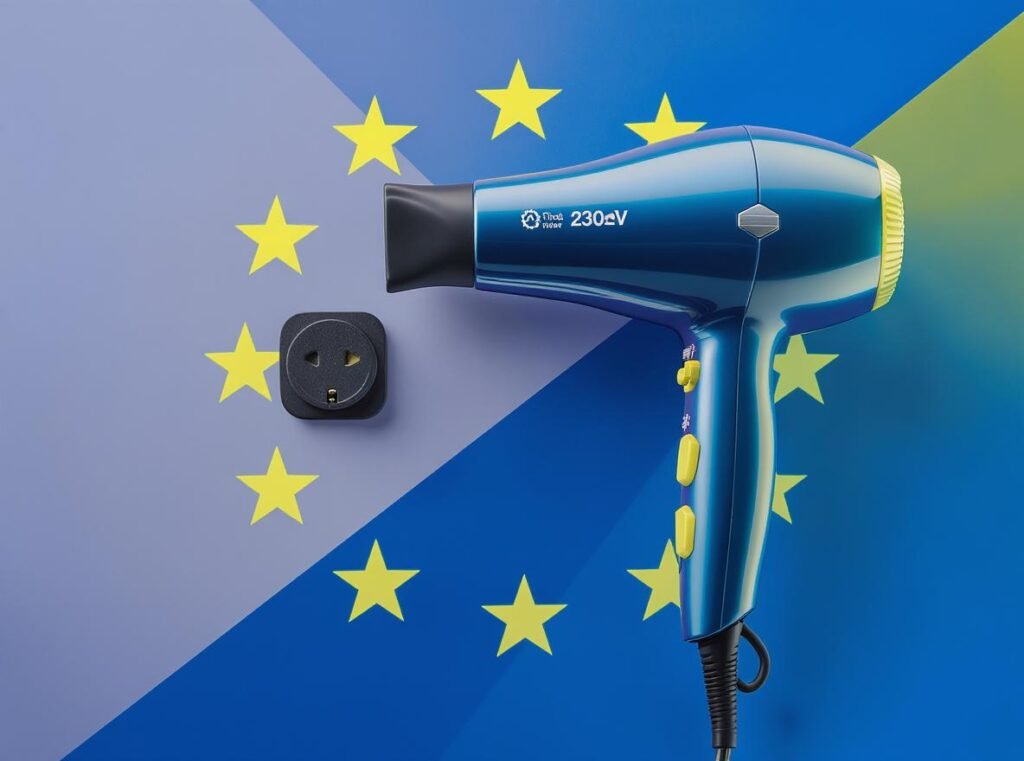
Hair dryers in Europe operate on 220-240 volts, most commonly 230V, at 50 Hz frequency. This higher voltage system allows for more efficient power transmission and enables hair dryers to achieve high performance with lower current draw.
European hair dryer specifications:
- Voltage: 220-240V (230V EU standard)
- Frequency: 50 Hz
- Power: 1000-2400 watts typical
- Efficiency: Higher than 120V systems
The voltage variations across European countries include:
| Country/Region | Voltage Range | Standard |
|---|---|---|
| Most EU Countries | 220-240V | 230V |
| United Kingdom | 230-250V | 240V |
| Switzerland | 210-230V | 220V |
| Germany | 220-240V | 230V |
| France | 220-240V | 230V |
This higher voltage system allows European hair dryers to be more compact while maintaining powerful performance. The reduced current requirements also mean less heat generation in wiring and components.
What Voltage Do Hair Dryers Use in Asia?
Asian countries predominantly use higher voltage systems similar to Europe, though with some regional variations.
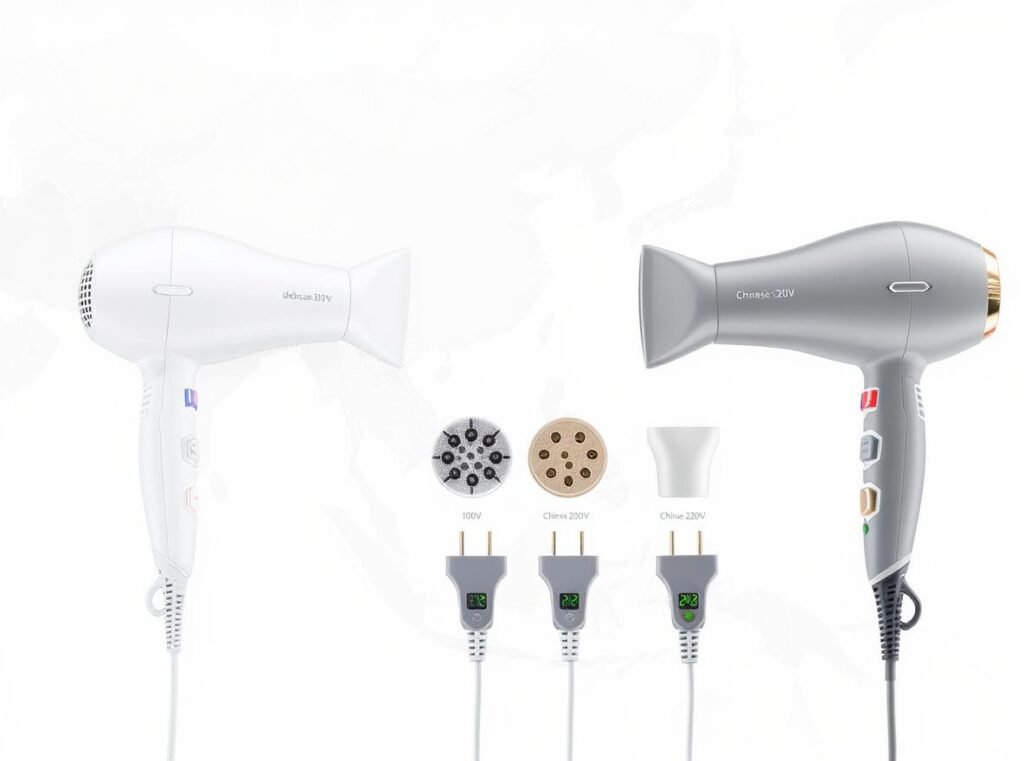
Most Asian countries use 220-240V systems for hair dryers, operating at 50 Hz frequency. However, Japan is a notable exception, using both 100V and 200V, making it unique in the Asian region.
The voltage landscape across Asia varies significantly:
Major Asian Markets:
- China: 220V, 50 Hz
- India: 230V, 50 Hz
- Japan: 100V and 200V, 50/60 Hz (unique dual frequency system)
- South Korea: 220V, 60 Hz
- Thailand: 220V, 50 Hz
- Singapore: 230V, 50 Hz
| Country | Voltage | Frequency | Notes |
|---|---|---|---|
| China | 220V | 50 Hz | Largest market |
| Japan | 100V/200V | 50/60 Hz | Unique voltage system |
| India | 230V | 50 Hz | Growing market |
| South Korea | 220V | 60 Hz | Advanced technology |
Japan’s voltage system is particularly interesting because it uses both 100V and 200V, creating unique compatibility challenges. Japanese hair dryers designed for 100V won’t work properly in other Asian countries without voltage conversion, while 200V models align better with international standards.
The manufacturing implications are significant. Asian hair dryer manufacturers often produce different models for domestic use versus export markets, requiring separate production lines for different voltage specifications.
What Voltage Do Hair Dryers Use in Australia and Africa?
Australia and most African countries follow the European voltage standard for their electrical systems.
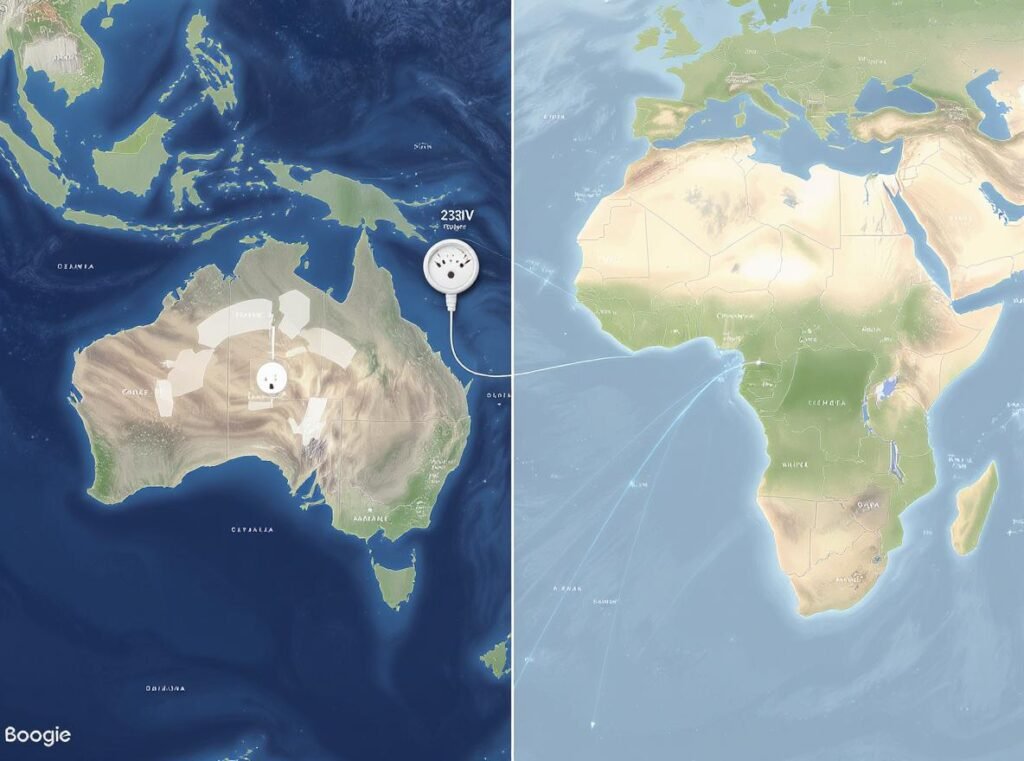
Australia uses 230V systems for hair dryers, while most African countries use 220-240V systems, commonly 230V. Both regions typically operate at 50 Hz frequency, aligning with European standards for simplified international trade and compatibility.
Australia:
- Voltage: 240V
- Frequency: 50 Hz
- Standard: Very stable, well-regulated power grid
- Plug type: Type I (angled flat blades)
Australia maintains one of the world’s most stable electrical systems, with consistent 240V delivery across the continent. This reliability makes it an excellent market for high-performance hair dryers.
Africa Regional Breakdown:
| Region | Voltage | Frequency | Market Characteristics |
|---|---|---|---|
| South Africa | 220-240V | 50 Hz | Most developed market |
| Nigeria | 230V | 50 Hz | Largest population |
| Kenya | 240V | 50 Hz | Growing middle class |
| Egypt | 220V | 50 Hz | Stable infrastructure |
Most African countries adopted European electrical standards during colonial periods and have maintained them. This consistency across the continent simplifies distribution and reduces inventory complexity for hair dryer suppliers.
The growing middle class in many African countries represents significant market opportunities for quality hair styling equipment, particularly in urban areas with reliable electrical infrastructure.
How Do Dual Voltage Hair Dryers Work?
Dual voltage hair dryers solve compatibility problems by automatically or manually adjusting to different electrical systems.
Dual voltage hair dryers can operate on both 110-127V and 220-240V systems, either through automatic voltage detection or manual switching. Most models feature a switch (often on the handle or base) to toggle between voltage ranges, while some automatically detect and adjust to the voltage.
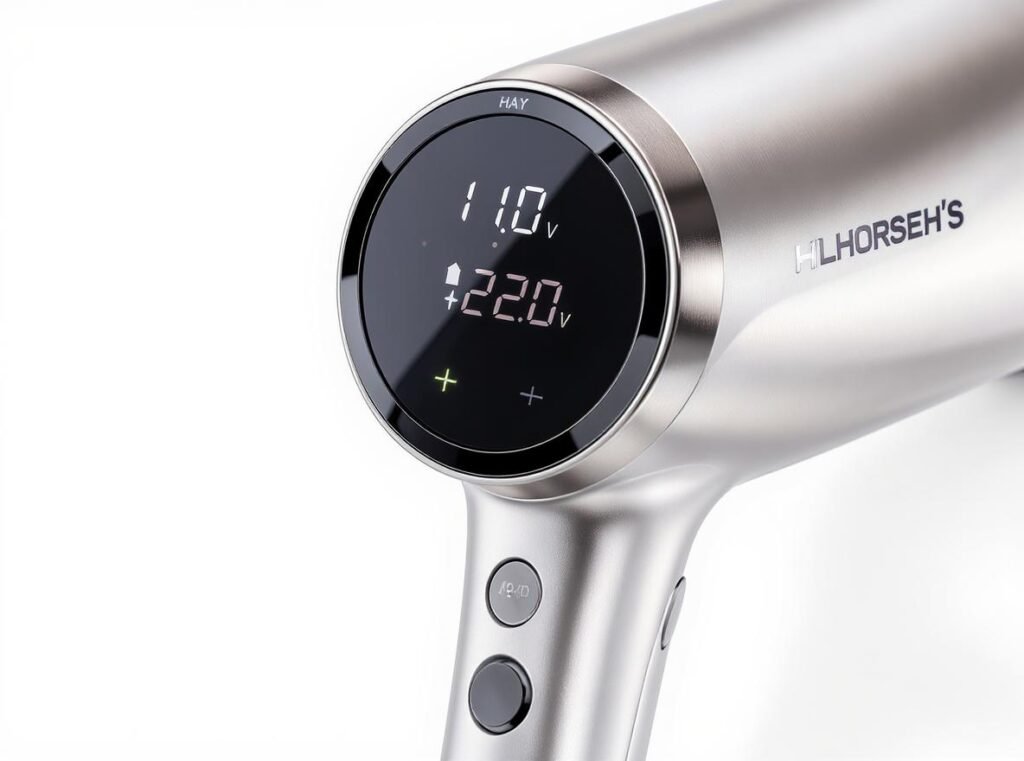
Some dual voltage models can change automatically but other hair dryers will feature a switch which allows you to operate between different voltage ranges depending on which country you are visiting.
Automatic Dual Voltage:
- Detects input voltage automatically
- Adjusts power output accordingly
- No user intervention required
- More expensive but convenient
Manual Dual Voltage:
- Features a voltage selector switch
- User must set correct voltage before use
- More affordable option
- Risk of user error
The technology behind dual voltage operation involves:
- Smart transformers: Automatically adjust output based on input
- Switching power supplies: Electronically regulate voltage
- Voltage detection circuits: Monitor input and adjust accordingly
For international businesses, dual voltage hair dryers offer significant advantages:
- Reduced inventory complexity
- Lower shipping costs
- Simplified product training
- Better customer satisfaction
However, dual voltage units typically cost 20-30% more than single voltage models, and the added complexity can impact reliability.
What Are the Risks of Using Wrong Voltage?
Using incorrect voltage with hair dryers creates serious safety and performance risks that can be costly and dangerous.
Using wrong voltage can cause immediate equipment damage, fire hazards, electrical shock, and poor performance. A 120V hair dryer on 220V will overheat and may be destroyed, while a 220V unit on 120V will barely work with weak airflow and poor heat output.
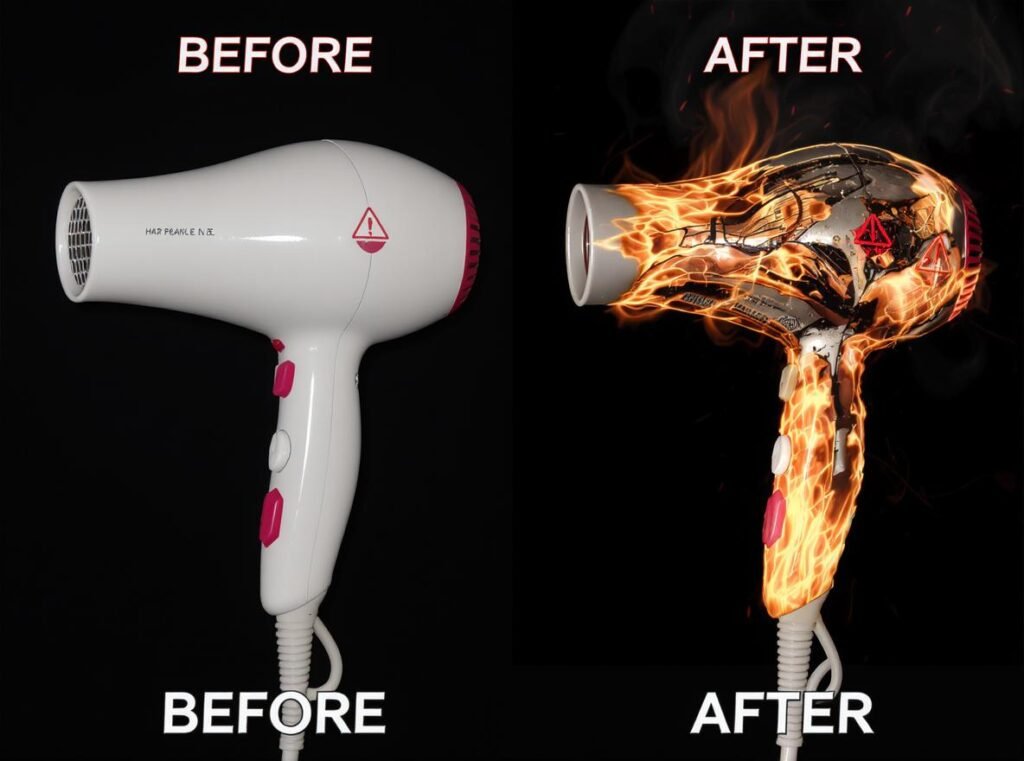
Using incorrect voltage creates several serious problems:
Overheating and Damage:
- 120V dryer on 220V causes overheating
- May burn out heating elements
- Can start electrical fires
- Equipment destruction within seconds
Poor Performance:
- 220V dryer on 120V results in weak airflow
- Insufficient heat output for effective drying
- Motor operates below optimal speed
- Inconsistent drying results
The financial implications are significant. Professional salon equipment can cost hundreds or thousands of dollars, making voltage mistakes extremely expensive. For businesses, wrong voltage usage can also create liability issues if equipment failures cause injuries or property damage.
Safety Precautions:
- Always check voltage labels before connecting
- Use proper voltage converters when necessary
- Invest in dual voltage equipment for international use
- Train staff on voltage requirements and risks
Many insurance policies may not cover damage from improper voltage usage, making prevention even more critical for commercial operations.
Do You Need Voltage Converters for Hair Dryers?
Voltage converters can enable hair dryer compatibility across different electrical systems, but they have limitations and requirements.
Heavy-duty voltage converters are required for hair dryers due to their high power consumption (1000-2000+ watts). Standard travel converters cannot handle hair dryer power requirements and will fail or create safety hazards. High-wattage devices like hair dryers may not work well with basic travel converters.
Converter Requirements for Hair Dryers:
- Minimum capacity: 2000+ watts
- Type: Heavy-duty transformers, not electronic converters
- Safety features: Overload protection, thermal cutoffs
- Size: Typically 2-5 pounds for adequate capacity
Important Considerations:
- Basic travel converters are not suitable for hair dryers
- Dual-voltage hair dryers are usually the safest choice
- Only plug adapters needed for dual-voltage units
- Voltage converters add bulk and weight for travel
| Converter Type | Power Capacity | Suitable for Hair Dryers | Cost Range |
|---|---|---|---|
| Electronic | Up to 200W | No | $20-50 |
| Light duty | Up to 800W | No | $50-100 |
| Heavy duty | 1000-3000W | Yes | $100-300 |
Converter Limitations:
- Heavy and bulky for travel
- Expensive to purchase
- May affect motor performance
- Heat generation during operation
- Not suitable for professional use
For occasional travel use, converters provide a solution. However, for regular international use or professional applications, dual voltage equipment offers better reliability and performance.
Alternative Solutions:
- Purchase dual voltage hair dryers
- Buy local equipment at destination
- Use hotel-provided hair dryers
- Rent professional equipment locally
What Should Wholesalers Know About Voltage Requirements?
Understanding voltage requirements is crucial for wholesalers, distributors, and retailers in the international hair dryer market.
Wholesalers must understand regional voltage differences to properly stock inventory, provide accurate product information, and avoid costly returns. Market compatibility is essential – ensure the hair dryers you import or distribute match the voltage standards of your target market.
Key Considerations for Wholesalers:
- Market Compatibility: Stock hair dryers that match regional voltage standards
- Clear Labeling: Provide voltage and compatibility information on packaging and manuals
- Dual Voltage Appeal: Stock dual voltage models to attract travelers and international customers
- Plug Compatibility: Consider plug shapes and provide adapters if necessary
- Safety Compliance: Only supply hair dryers meeting electrical safety regulations of destination countries
Regional Stocking Strategy:
| Target Market | Required Voltage | Recommended Approach |
|---|---|---|
| North America | 110-120V | Stock single voltage units |
| Europe | 220-240V | Stock single voltage units |
| International | Mixed | Focus on dual voltage models |
| Professional | Various | Offer both options |
Business Benefits of Proper Voltage Management:
- Reduced return rates and associated costs
- Improved customer satisfaction and loyalty
- Better inventory turnover
- Enhanced reputation as knowledgeable supplier
- Compliance with import/export regulations
For international distributors, consider offering voltage conversion services or partnering with electrical contractors to provide complete solutions.
Manufacturer Partnerships:
Working with manufacturers like Conason who understand international voltage requirements can streamline your operations. Our P1C high-speed hair dryer is available in multiple voltage configurations to meet diverse market needs.
Summary
Hair dryer voltage requirements vary significantly worldwide, with North America using 110-127V systems (typically 120V) while most other regions including Europe, Asia, Australia, and Africa use 220-240V systems (typically 230V). Understanding these differences is essential for safe operation, equipment longevity, and business success. Dual voltage solutions offer flexibility for international use, while voltage converters provide temporary solutions with significant limitations for high-wattage appliances like hair dryers.
For wholesalers and retailers, proper voltage management reduces returns, improves customer satisfaction, and enhances business reputation. Whether you’re traveling internationally or supplying global markets, voltage compatibility should be a primary consideration in your hair dryer selection and inventory decisions.
Ready to explore professional-grade hair dryers designed for international markets? Visit our products collection to discover voltage-optimized solutions, or learn more about our P1C high-speed hair dryer available in multiple voltage configurations. Contact us today to discuss wholesale opportunities and voltage-specific solutions for your market.