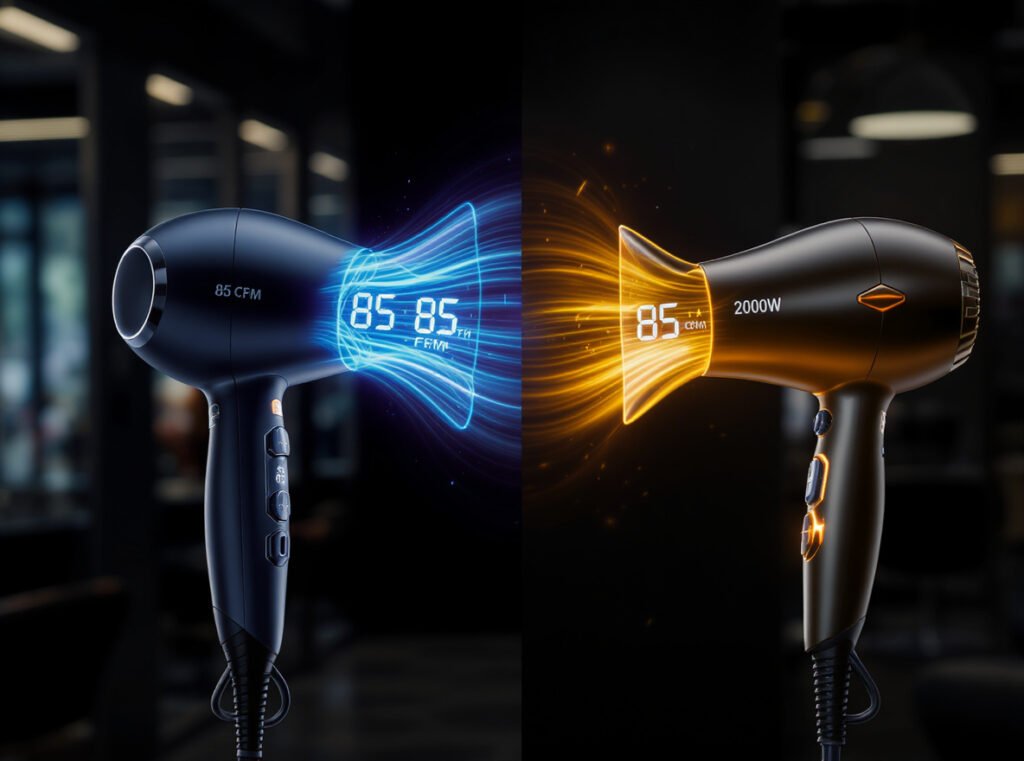
When shopping for hair dryers, you’ve likely noticed manufacturers love advertising high wattage numbers. But here’s what most brands don’t want you to know: wattage only tells part of the story. What if we told you that a hair dryer’s airflow measured in CFM (Cubic Feet per Minute) could actually be more critical than its wattage for real-world performance?
Yes, CFM is often more important than wattage because it measures actual air volume movement, which directly affects drying speed and efficiency. While wattage indicates total power consumption, 80-90% typically goes to heating elements, leaving only 10-20% for the motor that actually moves air.
Let’s dive deeper into why understanding this difference could revolutionize how you choose hair dryers for your business.
What Does CFM Actually Mean in Hair Dryers?
Most people focus on wattage when buying hair dryers, but CFM provides the real performance picture.
CFM (Cubic Feet per Minute) measures the volume of air your hair dryer moves in sixty seconds. Professional hair dryers typically range from 50-245 CFM, with higher-end models delivering significantly more airflow than their wattage might suggest.
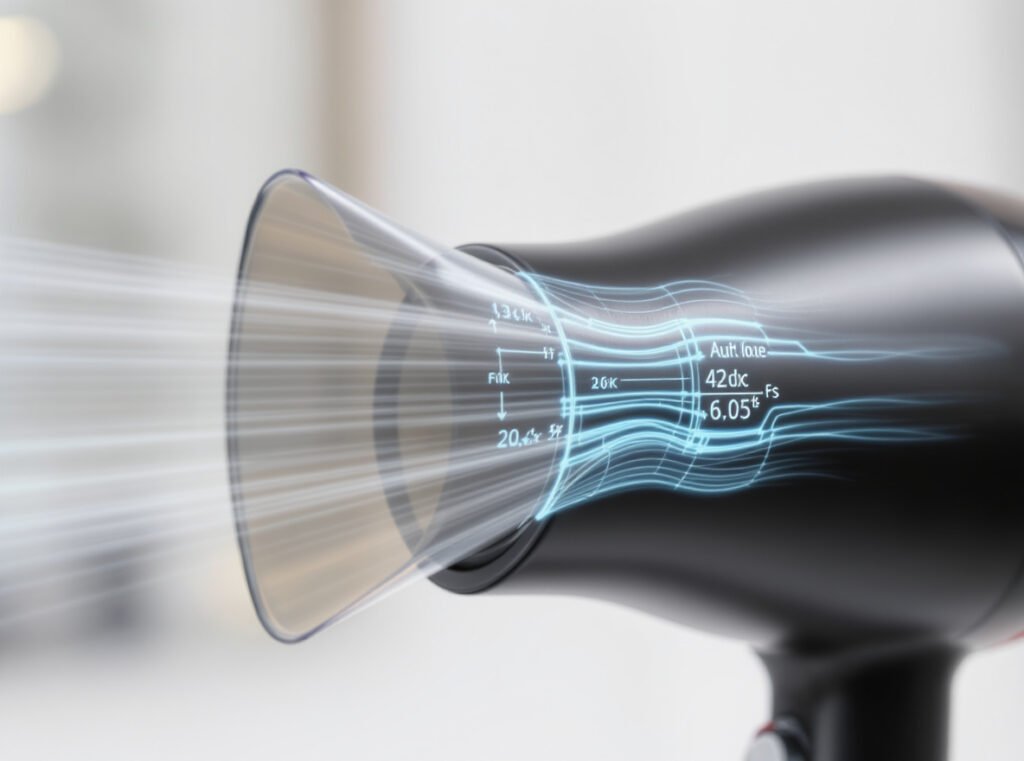
The distinction becomes clear when you compare actual specifications. Consumer models typically deliver 41-75 CFM, while professional salon dryers often exceed 100 CFM. This dramatic difference explains why salon equipment performs so much better despite sometimes having similar wattage ratings.
Understanding CFM ranges helps set realistic expectations:
| Hair Dryer Category | Typical CFM Range | Performance Level | Best Applications |
|---|---|---|---|
| Basic Consumer | 30-50 CFM | Light-duty drying | Occasional home use |
| Premium Consumer | 50-85 CFM | Enhanced performance | Daily styling routines |
| Professional Salon | 100-200 CFM | High-speed drying | Commercial environments |
| Ultra-Professional | 200+ CFM | Maximum efficiency | Heavy-duty salon work |
The science behind these numbers reveals why CFM matters more than most realize. Air volume directly correlates with moisture removal capability, making it the primary factor in drying speed and effectiveness.
Why Wattage Doesn’t Tell the Whole Story
Here’s the industry secret most manufacturers won’t advertise: wattage distribution reveals the real performance story.
In typical AC motor hair dryers, 80-90% of electricity consumption powers the heating element, while only 10-20% drives the motor that creates airflow. A 2000-watt dryer might use 1800 watts for heat and merely 200 watts for air movement.
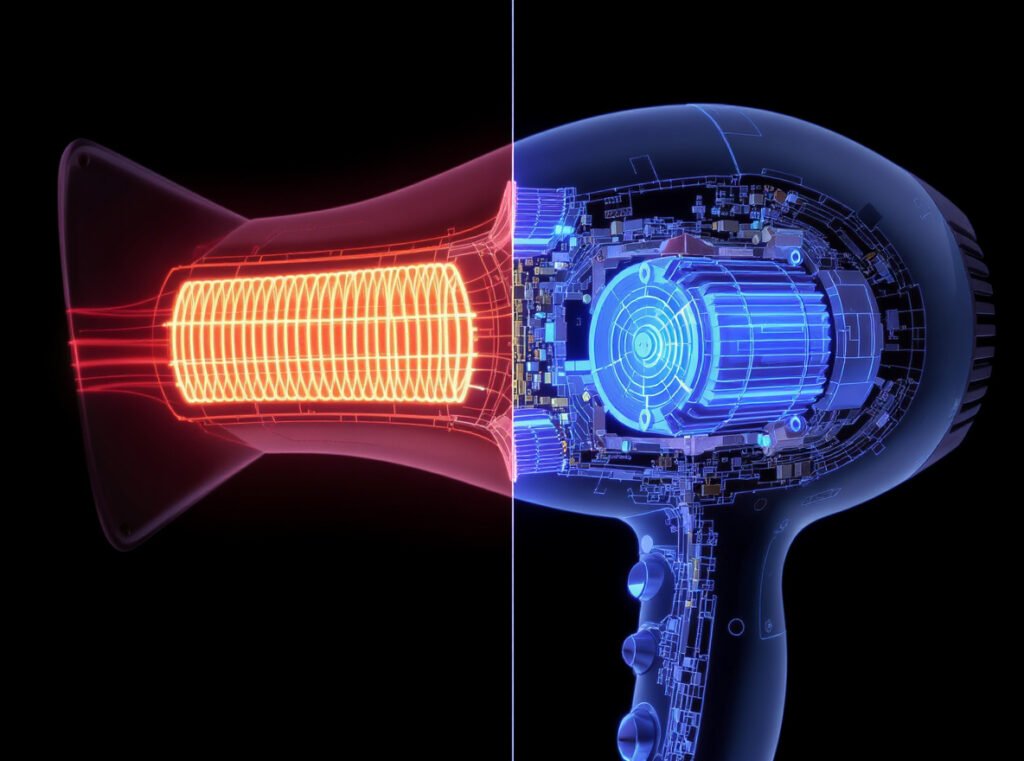
This explains why a well-engineered 1400-watt dryer can dramatically outperform a poorly designed 2200-watt model. Think of it like comparing car engines – a smaller, more efficient engine can outperform a larger, inefficient one through superior design and engineering.
The wattage misconception creates several problems:
Energy Waste Without Performance
High-wattage dryers often consume more electricity without proportional performance gains, creating unnecessary operating costs for salons and consumers.
Heat Damage Risk
Excessive heat without adequate airflow creates localized hot spots that damage hair cuticles rather than efficiently removing moisture.
Marketing Manipulation
Manufacturers use high wattage numbers as marketing tools, knowing consumers associate higher numbers with better performance, regardless of actual effectiveness.
Performance Prediction Failures
Wattage alone cannot predict drying speed, hair health outcomes, or user satisfaction levels.
When CFM Becomes More Critical Than Wattage
Understanding when CFM outweighs wattage importance transforms your selection strategy completely.
CFM becomes more critical for thick hair types, professional applications, heat-sensitive hair, and humidity management. High airflow with moderate heat often delivers superior results compared to high wattage with restricted air movement.
Professional Salon Environments
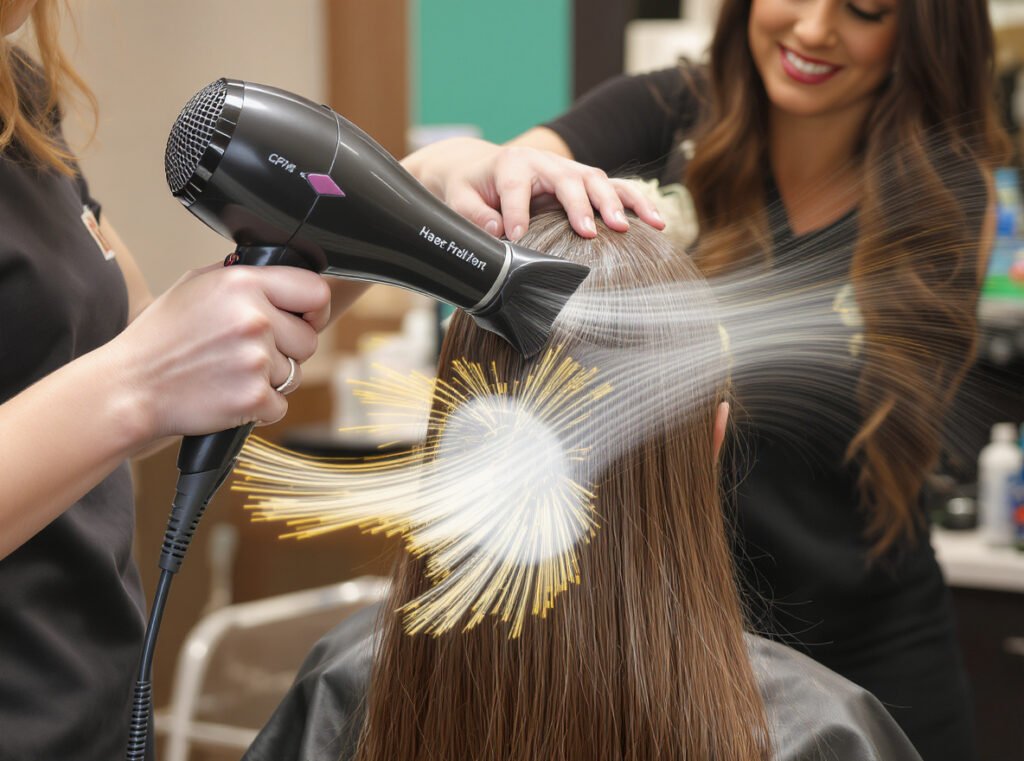
Stylists working with multiple clients daily need consistent, powerful airflow to maintain efficiency. Professional dryers with 130-245 CFM ratings enable completing blowouts significantly faster than consumer models with similar wattage but lower airflow.
Thick and Dense Hair Management
Dense hair requires strong airflow to penetrate multiple layers and move moisture away from the scalp effectively. Heat alone cannot efficiently work through thick hair without adequate air volume.
Damaged Hair Protection
For chemically processed, colored, or naturally fragile hair, high CFM with moderate temperature provides gentler drying than high-heat, low-airflow approaches that can cause additional damage.
Consider these real-world scenarios:
- Fine Hair: Benefits from 50-75 CFM with moderate wattage (1200-1600W) for controlled styling
- Medium Hair: Performs well with 75-100 CFM across various wattage levels
- Thick Hair: Requires 100+ CFM regardless of wattage for effective moisture removal
- Professional Use: Demands 130+ CFM for consistent performance across hair types
The Science Behind Effective Hair Drying
Hair drying operates on fundamental physics principles that explain why CFM often trumps wattage.
Effective hair drying requires both heat for water evaporation and airflow for moisture transport. Heat converts liquid water to vapor, while airflow carries that vapor away before it can re-condense on hair strands.
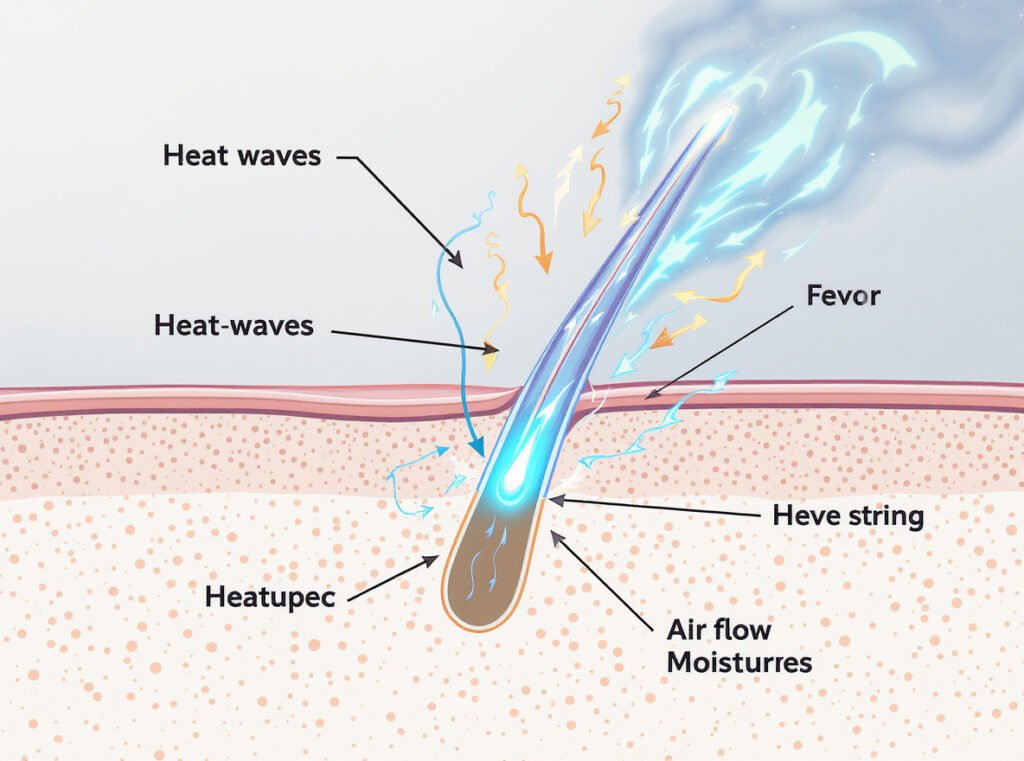
The drying process involves multiple scientific mechanisms working simultaneously:
Evaporation and Transport
Moving air carries away water molecules as they transition from liquid to gas, preventing re-condensation that would slow the drying process.
Heat Distribution Management
Airflow ensures even temperature distribution across all hair sections, preventing localized overheating that damages protein structures and causes brittleness.
Cuticle Smoothing Effects
Properly directed airflow helps smooth hair cuticles when flowing from root to tip, enhancing shine and reducing frizz through mechanical action.
Moisture Displacement
High-velocity air physically removes water molecules from hair shafts before they can re-absorb, especially important in humid environments.
The most effective drying combines four critical elements:
- Adequate heat for initial evaporation
- Sufficient air velocity for moisture transport
- Proper air volume for complete coverage
- Consistent airflow for even results
When these factors work harmoniously, drying becomes both faster and gentler on hair structure, explaining why high-CFM dryers often outperform high-wattage alternatives.
How to Evaluate CFM vs Wattage for Your Needs
Smart evaluation requires understanding how CFM and wattage interact for different applications.
Evaluate your primary requirements first: speed and efficiency favor CFM priority, while maximum heat for specific styling techniques may require higher wattage. The best performers optimize both specifications effectively.
Motor Technology Considerations
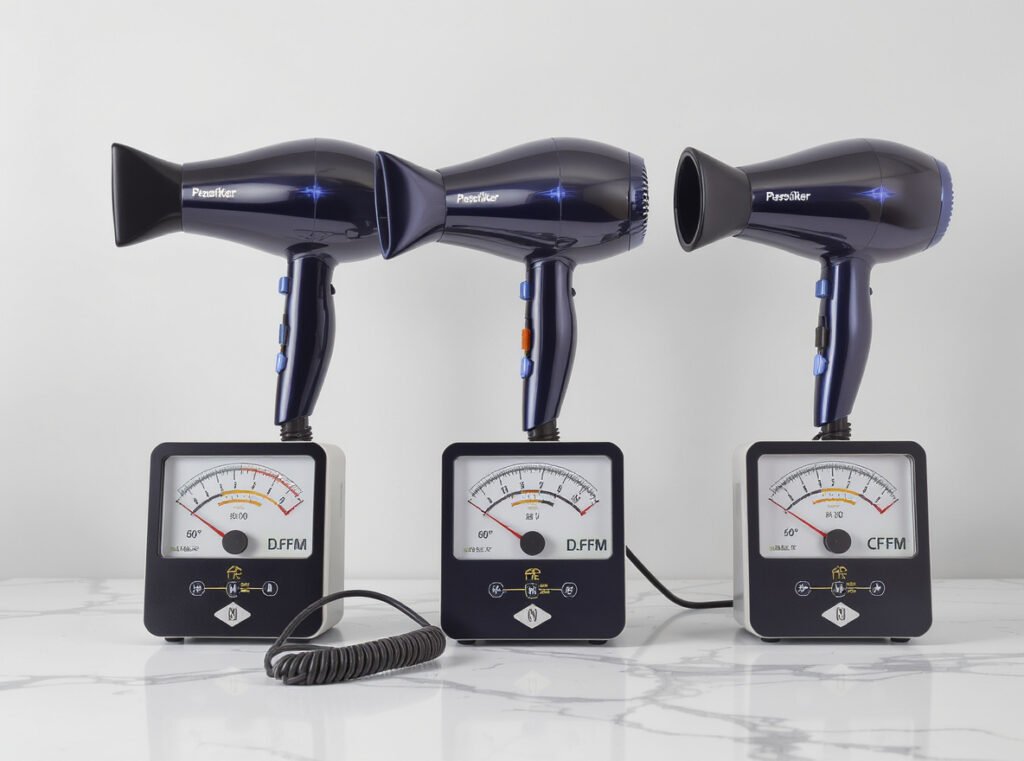
DC brushless motors often deliver higher CFM per watt consumed compared to traditional AC motors, making them more efficient for airflow generation. This technology explains why some modern dryers achieve excellent performance with moderate wattage.
Hair Type Matching Strategy
- Fine hair responds well to balanced CFM/wattage ratios
- Medium hair adapts to various combinations
- Thick hair demands CFM priority regardless of wattage
- Damaged hair benefits from high CFM with controlled heat
Professional Requirements
Salon environments benefit from dryers prioritizing CFM specifications over raw wattage, as consistent airflow reduces service time more effectively than pure heat generation.
Key evaluation criteria include:
| Factor | CFM Priority | Wattage Priority | Reasoning |
|---|---|---|---|
| Drying Speed | High | Medium | Airflow removes moisture faster |
| Energy Efficiency | High | Low | Better CFM/watt ratios |
| Hair Health | High | Medium | Reduces heat exposure time |
| Styling Versatility | Medium | High | Heat helps with shaping |
| Professional Use | High | Medium | Consistency matters most |
Professional Applications: Why CFM Rules
Professional hairstylists and salon owners consistently prioritize CFM specifications for compelling business reasons.
Professional environments demand speed, consistency, and reliability. High-CFM dryers reduce client service time, prevent equipment overheating during extended use, and deliver consistent results across diverse hair types throughout busy workdays.

The numbers speak for themselves in professional settings. Salon dryers with 130-245 CFM ratings enable stylists to complete services significantly faster than consumer models, directly impacting revenue potential and client satisfaction.
Professional Performance Advantages:
Time Efficiency Benefits
- Faster client turnover increases daily revenue capacity
- Reduced physical fatigue from shorter styling sessions
- More predictable scheduling throughout busy periods
- Consistent performance regardless of hair thickness
Equipment Longevity Factors
- Reduced motor strain during extended operation periods
- Better heat dissipation prevents premature component failure
- Lower maintenance requirements and replacement costs
- Superior build quality in high-CFM professional units
Client Satisfaction Elements
- Faster service without compromising quality results
- Less heat exposure reduces hair damage complaints
- More comfortable experience with efficient airflow
- Professional results that justify premium service pricing
The Conason P1C high-speed hair dryer exemplifies professional-grade CFM performance, delivering exceptional airflow with advanced motor technology designed for commercial environments. This balance of high CFM output with energy efficiency addresses the operational cost concerns critical for business success.
For wholesale buyers targeting salon markets, emphasizing CFM specifications differentiates products in competitive environments where performance directly affects profitability.
Common Misconceptions About Hair Dryer Performance
Several persistent myths continue influencing purchasing decisions across consumer and professional markets.
The biggest misconception remains that higher wattage automatically equals better performance. Motor efficiency, fan design, and airflow engineering typically matter more than raw power consumption for actual drying effectiveness.
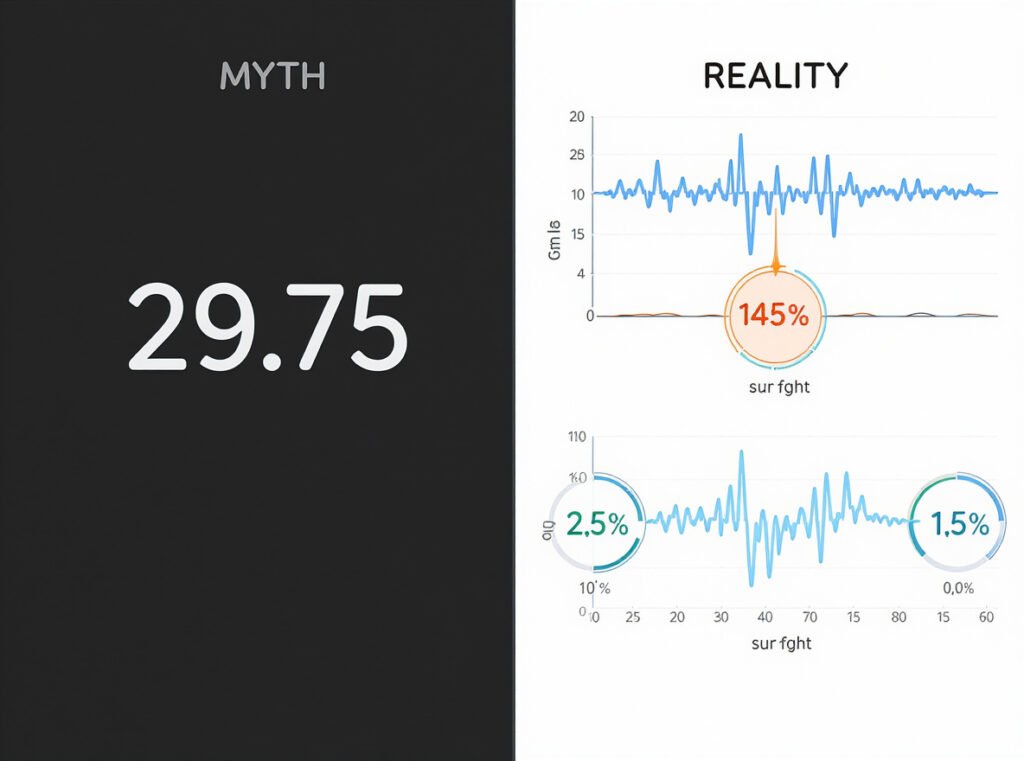
Myth 1: “More Watts Always Mean Faster Drying”
This assumes perfect efficiency that rarely exists in practice. Many high-wattage dryers waste energy on heat generation while delivering poor airflow performance.
Myth 2: “CFM Only Matters for Professionals”
Home users benefit equally from efficient CFM performance. Better airflow means reduced heat exposure and healthier hair outcomes over time, regardless of usage frequency.
Myth 3: “Professional Dryers Must Be Heavy”
Modern brushless motor technology enables powerful airflow in lightweight packages, debunking traditional associations between weight and performance capability.
Myth 4: “Wattage Determines Motor Power”
Motor efficiency varies dramatically between designs. Some low-wattage brushless motors outperform high-wattage traditional motors in airflow generation through superior engineering.
Reality Check:
- Efficiency trumps raw power consumption
- CFM provides measurable, real-world benefits
- Professional features benefit all user categories
- Total performance requires both adequate wattage and CFM optimization
Understanding these misconceptions helps wholesale buyers educate customers effectively and position products based on genuine performance benefits rather than misleading marketing claims.
Making the Right Choice for Your Business
Selecting hair dryers for wholesale requires balancing technical performance with market demands and competitive positioning.
Focus on CFM specifications when targeting professional customers, salons, and serious styling enthusiasts. For price-conscious consumers, emphasize balanced wattage-to-CFM ratios that deliver superior value compared to high-wattage, low-performance alternatives.

Market Segmentation Strategies:
Professional Market Approach
- Highlight CFM performance and motor efficiency advantages
- Emphasize durability and consistent output capabilities
- Focus on time-saving and operational cost benefits
- Provide detailed technical specifications and performance data
Consumer Market Education
- Balance traditional wattage marketing with CFM education
- Explain benefits in practical, understandable terms
- Include both specifications to satisfy different knowledge levels
- Offer clear performance tier differentiation across price points
Wholesale Positioning Advantages
For retailers and distributors, consider featuring models like the Conason P1C that deliver exceptional CFM performance with competitive wattage ratings. This combination satisfies both educated buyers seeking genuine performance and traditional customers expecting high wattage numbers.
Product positioning should emphasize:
- Demonstrable drying performance benefits over competitors
- Energy efficiency advantages for cost-conscious buyers
- Professional-quality results accessible to all users
- Long-term hair health benefits through reduced heat exposure
Visit our Conason P1C high-speed hair dryer to experience superior CFM performance, or explore our complete product collection for high-performance options that optimize both airflow and energy efficiency.
Summary
CFM often proves more important than wattage because it measures what matters most – actual air volume that efficiently removes moisture from hair. While wattage indicates total power consumption, most goes to heating elements rather than airflow generation, making CFM the better predictor of real-world drying performance.
For wholesale success, emphasize CFM specifications to differentiate your products and educate customers about genuine performance indicators rather than misleading marketing metrics. Contact us today to discuss how our high-CFM hair dryers can strengthen your product portfolio and satisfy the most demanding professional markets.